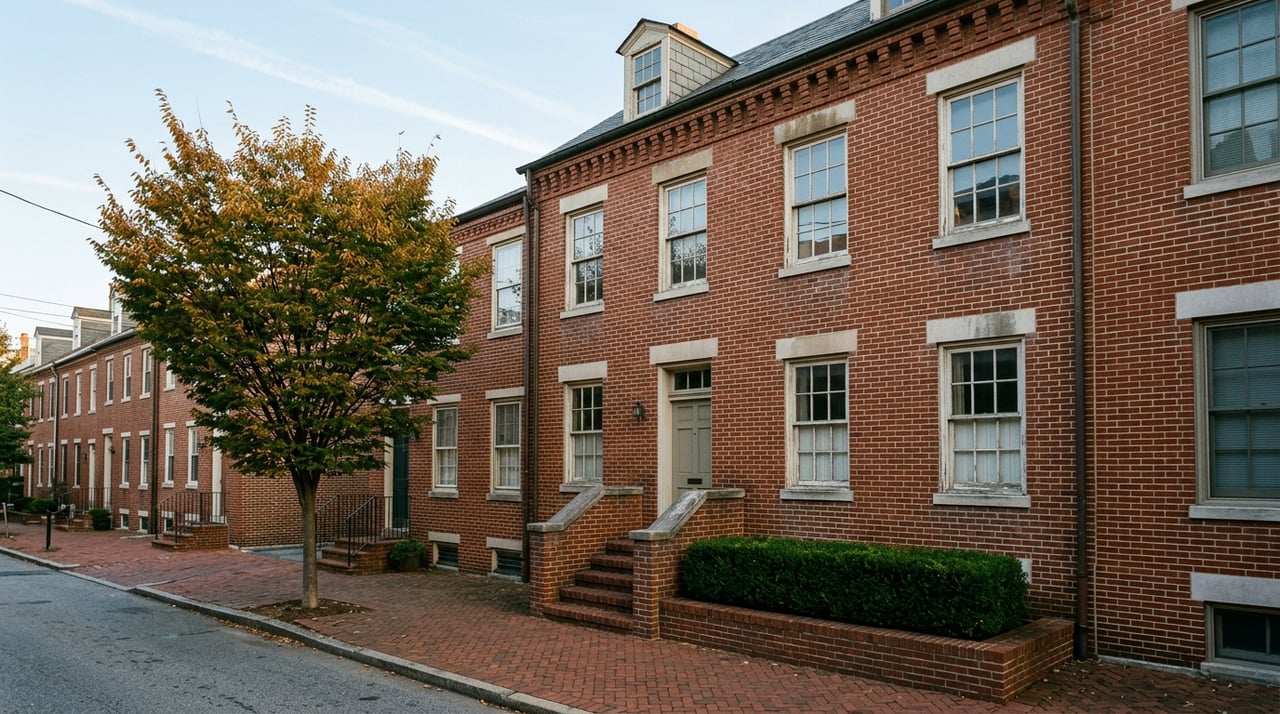
Soulard Market Just Finished a $6 Million Renovation. Most of It You Can't See on a Saturday.
September 17, 2026
September 17, 2026
"It's the biggest investment that the city has made in the farmers market in decades." That's how Bob Ray, who has managed Soulard Farmers Market since 2021, described the roughly $6 million the city put into the market across 2024 and 2025. If you've walked through on a sunny Saturday and thought it looked about the same as always, that's the point. The money didn't go toward looking different. It went toward surviving winter, which is why the real proof of it showed up on a cold Wednesday morning last season, not on Instagram.
Saint Louis City put roughly $4.5 million into the market in 2025, covering a full roof replacement, tuckpointing on the historic brick, new tarps and banners, and updated electrical and lighting. That followed a $1.5 million phase in 2024 that tackled something far less photogenic: the market's century-old boiler.
That boiler was replaced with a new HVAC system, and the internal halls got heating for the first time in the market's modern history, just in time for last winter. Ray has said the installation brings heat to about 40 percent of the vendor stalls. For a market that stays open all 52 weeks of the year, Wednesday through Saturday, that's not a cosmetic upgrade. It's the difference between a vendor deciding to grind through February and one who decides it isn't worth it anymore.
The historic character stays intact on purpose. The 1929 Grand Hall, built in an Italian Renaissance H-shaped layout with four open-air wings, still looks like it did. What changed is underneath it: new roofing, a modern heating plant, and infrastructure that was, by most accounts, decades overdue.
Soulard Market's habit of quietly incubating businesses is the part of this story that doesn't show up in a ribbon-cutting photo. Ray has pointed to two examples that map exactly onto the story of the market's real function in this neighborhood: Freddie Lee's Gourmet Sauces, a stall that grew into a sauce brand now sold in roughly 1,000 stores, and Lona's Lil Eats, which started at the market and went on to become a 2019 James Beard Award semifinalist before opening its own location.
Both started with the same low overhead and steady foot traffic that every other stallholder gets. Affordable rent and a built-in customer base turn the market into a low-risk proving ground, which is exactly why it keeps producing graduates instead of just produce. If you're the kind of shopper who likes discovering something before it has its own storefront, this is where that happens, and it's been happening at Soulard longer than most of the restaurants in the neighborhood have existed.
That incubator function only works if the market stays financially viable for the vendors at the bottom of that ladder. That's the practical argument for the renovation money going toward heat and roofing instead of, say, a fresh coat of paint. A vendor who can't survive January isn't around in July to become the next Freddie Lee's.
Here's the detail that trips up a lot of people who assume Saturday is simply the market at its most crowded version of itself. It's not a bigger version of the same market. It's structurally a different one.
| Day | Hours | Vendor Participation |
|---|---|---|
| Wednesday | 8 a.m. to 5 p.m. | 10% |
| Thursday | 8 a.m. to 5 p.m. | 10% |
| Friday | 8 a.m. to 5 p.m. | 35% |
| Saturday | 8 a.m. to 5 p.m. | 100% |
| Sunday | Closed | Closed, except Sal's Produce |
If you've only ever gone on Saturday, you've seen 148 stalls doing what they're built to do. If you've gone on a Wednesday and found it half empty, that's not the market having a bad day. That's 90 percent of the stalls simply not showing up, by design. Farmers and vendors treat Wednesday and Thursday as slow prep days, ramp up Friday, and go all in on Saturday when the customer base is there to support it.
For residents, that rhythm is worth knowing on its own terms. A Wednesday trip is quieter, faster, and a decent way to catch the produce vendors and the handful of regulars who do show up every day, without the crowd. A Saturday trip is the full experience, all four wings open, the Grand Hall shops running, and the closest thing the market has to its original 19th century energy.
Soulard Market gets described as founded in 1779, and there's truth in that. Farmers were reportedly pulling wagons onto that flat meadow at the very start of the city's history, and the market has operated in some form since then, making it the oldest continuously operating market west of the Mississippi. But the building most people picture when they think of Soulard Market, the Grand Hall with its arched entries and pyramidal roof, has only been standing since 1929.
That's the anniversary the market actually celebrated this year, with a Founder's Day Bluegrass Festival on August 29 honoring Julia Soulard, whose donation of the land in the 1840s made the market's permanent home possible. It's a small distinction, but it matters if you're trying to understand what "97 years" refers to when you hear it. The market itself is nearly 250 years old. The building you're standing in is 97.
None of this changes what the market sells or what it costs to shop there. What it changes is durability. A market that just received its largest capital investment in decades, with heat finally reaching a real share of its vendor stalls, is a market the city is betting will still be standing in the same shape a generation from now. For a neighborhood where the market functions as much as a small business nursery as a place to buy produce, that's the kind of investment that pays off slowly, one winter at a time, one Freddie Lee's at a time.
If you're already a regular, the practical takeaway is simple: know which day you're actually walking into, and keep an eye on the quieter stalls on a Wednesday. Some of what's sitting there now might have its own storefront in five years.
If you're new to the neighborhood or just getting to know it, that's exactly the kind of texture that doesn't show up on a map. It's also the kind of thing we like talking about with clients who are weighing what it actually feels like to live near a place like Soulard, not just what the listing says. If that's the conversation you're looking to have, The Kraemer Realty Group would love to connect.
Stay up to date on the latest real estate trends.
Your home is more than an address—it’s a reflection of your lifestyle. Partner with an expert who truly understands what luxury means.