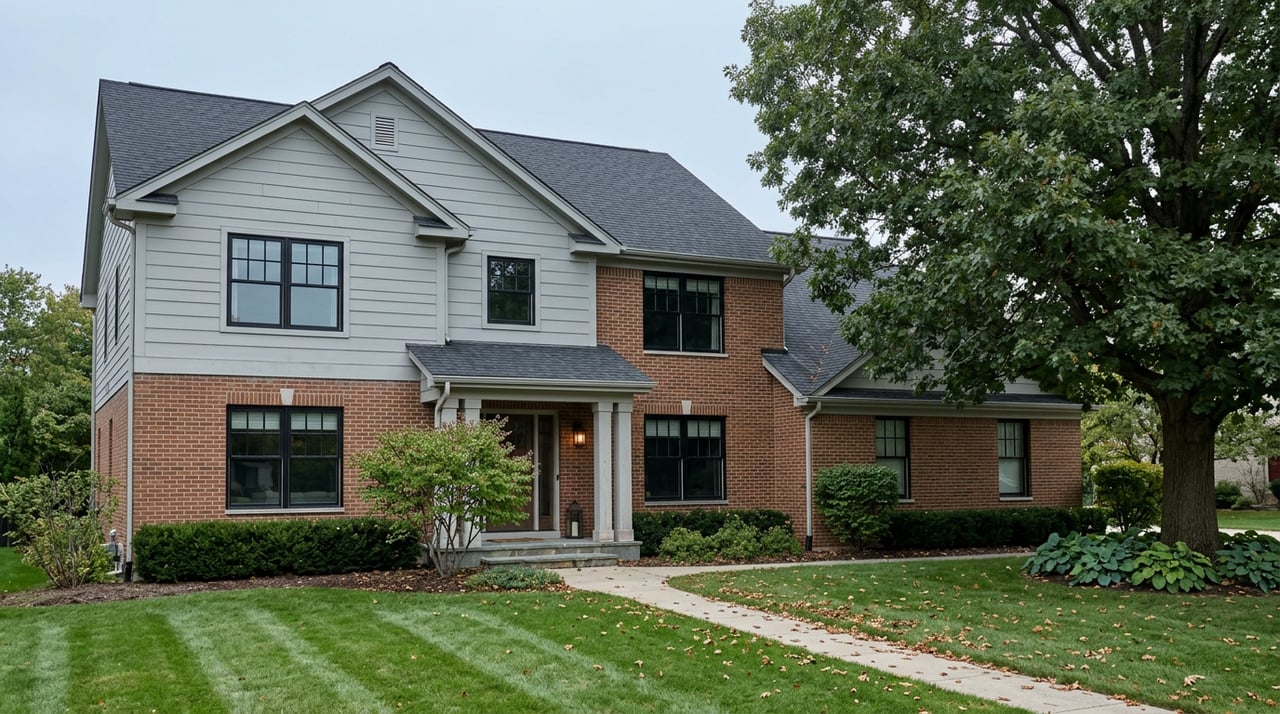
O'Fallon Costs More to Buy. St. Peters Costs More to Own.
September 24, 2026
September 24, 2026
Two St. Charles County suburbs, ten minutes apart on Interstate 70, show up on almost every relocation shortlist together. O'Fallon and St. Peters get compared so often that buyers start treating the median price as the whole story: O'Fallon costs more, St. Peters costs less, decision made. As of mid-2026, Zillow's Home Value Index put the typical O'Fallon home at $379,237, up 0.9% over the previous year, against $327,776 in St. Peters, up 3.3%. That's roughly a $51,000 gap in the direction everyone expects.
What doesn't show up on the listing page is the number that moves in the opposite direction. Property tax analysis firm Ownwell tracks effective tax rates across St. Charles County and found St. Peters carrying the highest rate of any city in the county, while O'Fallon sits well below it. Run that rate against each city's home value and the annual tax bill on the "cheaper" house in St. Peters can land higher than the bill on the pricier one in O'Fallon. The sticker price isn't lying. It also isn't the number that determines what lands in your mortgage payment each month.
Start with what a portal search actually shows. O'Fallon's home values have been essentially flat over the past year, up less than a point, while St. Peters has climbed faster, up 3.3% over the same period. O'Fallon is still the pricier city in raw dollars, but the two are closing distance, not widening it. A buyer working off last year's mental math about which suburb is the "affordable one" is already working from a narrower gap than they think.
O'Fallon's higher price tag lines up with what's actually being built there. The city has grown 19.2% in population since 2010, expanding from roughly 79,964 residents to more than 95,000, and a meaningful share of its current housing stock reflects that growth: new subdivisions, larger floor plans, and homeowners association fees that come standard with them. St. Peters, built out earlier, carries an older and more varied stock, which is part of why its median sits lower even as demand pushes it upward.
Here's where the story flips. Ownwell, which tracks effective property tax rates (the actual tax bill divided by a home's market value, not the posted mill levy) across Missouri, found St. Charles County's highest effective rate in Saint Peters, at 1.33%. O'Fallon's effective rate came in at 1.08%, slightly above the national median but well under what St. Peters homeowners carry. Ownwell attributes the spread to differences in school district levies and special assessment districts that stack on top of the base county rate, and those layers don't correlate with a home's price. A $330,000 house and a $600,000 house in the same St. Peters zip code pay the same rate, just scaled to value.
Put the two numbers side by side and the pattern is hard to miss.
| City | Median Home Value (mid-2026) | Effective Property Tax Rate | Estimated Annual Tax |
|---|---|---|---|
| O'Fallon | $379,237 | 1.08% | ~$4,096 |
| St. Peters | $327,776 | 1.33% | ~$4,359 |
That right-hand column is a calculation, not a bill, built by multiplying each city's Zillow-reported home value by Ownwell's published effective rate for that city. It won't match any individual homeowner's actual statement, which depends on assessed value, exemptions, and the specific taxing districts a parcel falls into. But as an apples-to-apples comparison of two similarly sized homes, it holds up: the St. Peters buyer who saves roughly $51,000 on the purchase price gives back a few hundred dollars a year in tax alone, and depending on the specific subdivision and school levy stack, sometimes more.
Spread that $263 annual difference across twelve payments and it's about $22 a month, not enough to reroute a decision by itself. The point isn't that St. Peters is secretly the more expensive city. It's that the $51,000 price gap most buyers carry into a mortgage conversation shrinks the moment taxes enter the math, and neither city's number tells the full story on its own. A lender's estimated monthly payment always folds taxes into the total, but a buyer eyeballing two listings side by side on a phone screen rarely does the same.
This matters most for buyers weighing a specific pair of homes rather than a citywide average. A newer O'Fallon build in a subdivision with a homeowners association, like Columbia Meadows near Interstate 70, adds a monthly HOA fee on top of the mortgage, since the association there handles yard maintenance as part of the deal. An older St. Peters ranch with no HOA might carry a lower total monthly cost even with the higher tax rate, once that fee is factored out. Neither city wins outright. The comparison only means something when it's run property by property.
The gap isn't an accident of geography. O'Fallon's city government has described its own tax structure in fairly plain terms: two levies, a general levy and a debt service levy, with the parks levy rolled back to zero back in 2008 after voters approved a stormwater sales tax to fund parks instead. As the city's overall tax base has grown through new construction, the general levy rate has trended down, since the same budget gets divided across more assessed value. Growth, in other words, has worked in O'Fallon's favor on the rate side, even as it's pushed prices up.
St. Peters, built out earlier and growing more slowly, doesn't get that same rate relief from new construction. Its tax base expands more through reassessment than through fresh subdivisions, and its rate reflects a more built-out community layering standard levies onto standard housing.
None of this is a knock on either city's spending. It's a mechanical difference in how fast each one's tax base grows and how that math flows through to homeowners.
O'Fallon's growth hasn't gone unquestioned. In 2024, city council approved a 311-home subdivision called the Villages at Post Farms on 104 acres along Highway N, despite objections from nearby Dove Meadows residents who worried about added traffic on the connecting streets. It's the same growth pattern reflected in projects like the Streets of Caledonia, a roughly $400 million mixed-use development near Interstate 64 and Highway DD built by Lombardo Homes and Fischer Homes, with about 657 new single-family homes and townhomes priced from $300,000 to over $1 million. That's the newer half of O'Fallon's market: master-planned, HOA-governed, and still under construction in places.
St. Peters tells a different story. Established neighborhoods like Avondale Heights, Cave Springs Estates, Brookwood Estates, and Tanglewood sit alongside midcentury ranch subdivisions where prices can start well under $300,000, blocks from newer construction pushing past $500,000 in areas like the Cottages at Wedgewood. It's a city where the housing stock spans decades rather than clustering in a single growth era, which is part of why a single median doesn't capture much about what a specific block will cost.
A few reference points worth keeping straight when comparing the two:
The practical move for a buyer choosing between these two cities isn't to pick the lower list price and assume the math follows. It's to ask for the actual effective tax rate on a specific address, check whether an HOA fee applies, and add both to the mortgage estimate before comparing two homes across city lines. St. Charles County publishes its sales and property tax rate information directly, and it's worth a look before signing anything.
The two suburbs aren't in competition so much as they're solving different problems for different buyers. One offers newer construction and the amenities that come with a fast-growing tax base. The other offers an older, more varied stock at a lower purchase price, with a tax rate that quietly closes some of that gap back up.
Does a higher tax rate mean St. Peters is a worse value? Not on its own. A higher rate applied to a lower home value can still land close to a lower rate applied to a higher one, which is exactly what's happening between these two cities right now. Value depends on what a specific home costs total, not on the rate in isolation.
Should I ignore median price altogether? No, but treat it as a starting point rather than the answer. Median price tells you what a typical home costs to buy. It says nothing about what a typical home costs to hold, and that second number is the one that shows up every month for as long as you own the house.
If you're weighing O'Fallon against St. Peters, or trying to figure out what a specific address will actually cost once taxes and HOA dues are on the table, Kraemer Realty Group can walk through the real numbers with you, property by property, before you write an offer. Let's Connect.
Stay up to date on the latest real estate trends.
Your home is more than an address—it’s a reflection of your lifestyle. Partner with an expert who truly understands what luxury means.